显示标签为“scientific paper”的博文。显示所有博文

2015年9月11日星期五

Research Status of the Quaternary Sedimentation in the Chengdu Basin

Scientific paper written by Zhao Xueqin1, Zhao Lijuan2, *, Wang Fudong1
Abstract: The Quaternary of the Chengdu Basin contains abundant geological information. After being studied for decades, there are still some disputes over the Quaternary sedimentary environment and evolution and the filling sequence of basin, etc., on the whole even though some common perspectives have been reached with regard to stratigraphic architecture and structural characteristics. Particularly, more aspects must be further studied, including gravel characteristics and response to tectonic activity.
Keywords: The Chengdu Basin, Quaternary, Sedimentation, Gravel
1.Introduction
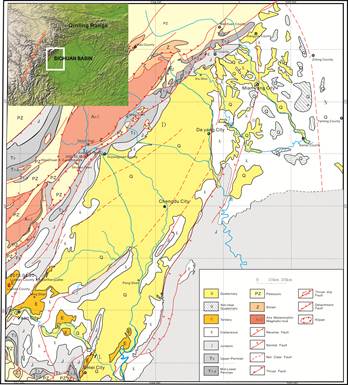
Figure 1. The geological map of Chengdu Basin.
Situated in the west of the Sichuan Basin, the Chengdu Basin stands between Longmen Mountain and Longquan Mountain in the east-west direction and extends to Xiushui of Qi’an County in the north and the regions of Mingshan and Pengshan in the south (Figure 1). In the late Cenozoic era, the edge of the basin descended abruptly to form a highly thick layer of Quaternary sediments dominated by sedimentation of mountain-front molasse and sand-conglomerate (Liu, 1983), while Longmen Mountain was uplifted dramatically at the southeastern edge of the Qinghai-Tibet Plateau. The formation is not only attributed to climatic conditions and effect of water flow, but also restricted by the strength and pattern of tectonic movement, so it contains abundant information on tectonic movement and deformation. In addition to ideal geographic and tectonic conditions, the region is always one of the key regions in the study on the late Cenozoic deformation of plateau, the uplift of plateau and the paleogeographic and palaeoclimatic changes (Xu et al., 1997). Meanwhile, it is also crucial to the study on the changes of climate & water system and ecological environment in the upstream region of the Yangtze River (Liang et al. 2014).
Read full scientific paper in SciencePG for free:http://bit.ly/1UGkpsC


2015年8月14日星期五

Nickel – the Ultimate Substitute of Coal, Oil and Uranium

Nickel – the Ultimate Substitute of Coal, Oil and Uranium
Pages: 1-6   |   Pub. Date: Nov. 25, 2014DOI: 10.11648/j.ijrse.s.2015040401.11  1049 Views   317 Downloads
Authors 
[01]
U. V. S. Seshavatharam, Honorary faculty, I-SERVE, Alakapuri, Hyderabad-35, AP, India
[02]
S. Lakshminarayana, Dept. of Nuclear Physics, Andhra University, Visakhapatnam-03, AP, India 
To cite this article 
U. V. S. Seshavatharam, S. Lakshminarayana, Nickel – the Ultimate Substitute of Coal, Oil and Uranium, International Journal of Sustainable and Green Energy. Special Issue:Current Research and Future of Renewable Energy. Vol. 4, No. 4-1, 2015, pp. 1-6. doi: 10.11648/j.ijrse.s.2015040401.11
Abstract 
During E-CAT test run some hidden and unknown energy is being coming out in the form of heat energy in large quantity. Based on the principle of conservation of energy and from the well known nuclear fusion and fission reactions it is possible to guess that, the E-CAT hidden energy may be in the form of binding of protons and neutrons of the Nickel and Lithium atomic nuclei. By considering the nuclear binding energies of (58@28)Ni, (62@28)Ni and (7@3)Li an attempt is made to understand the energy liberation mechanism in E-CAT. With reference to the net energy production of (5825 ± 10%) Mega Joules liberated from one gram Ni of the E-CAT’s 32 days third party test run, it can be suggested that, for every transformation of (58@28)Ni to (62@28)Ni via(7@3)Li, liberated heat energy is 3.64 MeV and for one gram of (58@28)Ni liberated energy is 5984 Mega Joules. For each transformation of (58@28)Ni to (62@28)Ni via(7@3)Li, 3 hydrogen atoms can be expected to be emitted. Note that, energy liberated for one gram of (58@28)Ni in cold fusion is 1.66 MWh and energy liberated for one gram of (235@92)U in nuclear fission is 22.6 MWh. Clearly speaking, energy released in Nickel based E-CAT is just 13.6 times less than the energy released in Uranium fission.
KeywordsCold Fusion, Low Energy Nuclear Reactions, E-CAT ( Energy Catalyzer)
Source:http://bit.ly/1hDGpTu