显示标签为“SciencePG”的博文。显示所有博文

2015年9月11日星期五

Research Status of the Quaternary Sedimentation in the Chengdu Basin

Scientific paper written by Zhao Xueqin1, Zhao Lijuan2, *, Wang Fudong1
Abstract: The Quaternary of the Chengdu Basin contains abundant geological information. After being studied for decades, there are still some disputes over the Quaternary sedimentary environment and evolution and the filling sequence of basin, etc., on the whole even though some common perspectives have been reached with regard to stratigraphic architecture and structural characteristics. Particularly, more aspects must be further studied, including gravel characteristics and response to tectonic activity.
Keywords: The Chengdu Basin, Quaternary, Sedimentation, Gravel
1.Introduction
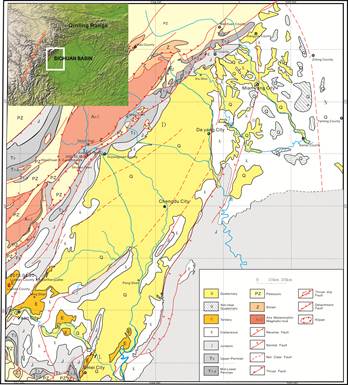
Figure 1. The geological map of Chengdu Basin.
Situated in the west of the Sichuan Basin, the Chengdu Basin stands between Longmen Mountain and Longquan Mountain in the east-west direction and extends to Xiushui of Qi’an County in the north and the regions of Mingshan and Pengshan in the south (Figure 1). In the late Cenozoic era, the edge of the basin descended abruptly to form a highly thick layer of Quaternary sediments dominated by sedimentation of mountain-front molasse and sand-conglomerate (Liu, 1983), while Longmen Mountain was uplifted dramatically at the southeastern edge of the Qinghai-Tibet Plateau. The formation is not only attributed to climatic conditions and effect of water flow, but also restricted by the strength and pattern of tectonic movement, so it contains abundant information on tectonic movement and deformation. In addition to ideal geographic and tectonic conditions, the region is always one of the key regions in the study on the late Cenozoic deformation of plateau, the uplift of plateau and the paleogeographic and palaeoclimatic changes (Xu et al., 1997). Meanwhile, it is also crucial to the study on the changes of climate & water system and ecological environment in the upstream region of the Yangtze River (Liang et al. 2014).
Read full scientific paper in SciencePG for free:http://bit.ly/1UGkpsC


2015年8月11日星期二

International Journal of Electrical Components and Energy Conversion


International Journal of Electrical Components an Energy Conversion (IJECEC) is a journal published bimonthly. It is dedicated to providing a multidisciplinary platform for the discussion of issues arising in the innovation and the development of robust methodologies dedicated to the design, control and optimization of electrical components and systems for varied electric power applications. It aims to promote rapid communication and dialogue among the researchers, scientists, engineers and policy makers working in the areas of design, optimization and control of electrical systems.
International Journal of Electrical Components and Energy Conversion (IJECEC) concern mainly the innovation and the development of robust methodologies dedicated to the design, control and optimization of electrical components and systems for various electric power applications. IJECEC covers the following topics:

  • • Energy conversion
  • • Power electronics
  • • Electrical systems
  • • AC Motors
  • • Brushless DC motors
  • • Asynchronous Motors
  • • Electrical machines and drives
  • • Optimization of electrical systems performances
  • • Technology and design of electrical components
  • • Control of electrical systems
  • • Identification of the electric motors
  • • Electro-thermal modeling of power systems
  • • Electrical transportation
  • • Renewable energy
  • • Experimental validations of designs and controls approaches of electrical systems
  • If you like, you can read this and download all scientific article in this journal for free in SciencePG.

2015年8月6日星期四

Research Seminars in Mathematical Finance: Stochastic Volatility Models, Option Pricing, Calibration

Authors
Lorella Fatone, Dipartimento di Matematica e Fisica, Università di Camerino, Camerino, Italy.
Francesca Mariani, Dipartimento di Scienze Economiche, Università di Verona, Verona, Italy.
Maria Cristina Recchioni, Dipartimento di Management, Università Politecnica delle Marche, Ancona, Italy.
Francesco Zirilli, Dipartimento di Matematica "G. Castelnuovo", Università di Roma "La Sapienza", Roma, Italy.
Description
This ebook contains a set of slides that can be used to present lectures in a graduate course or in a research seminar in mathematical finance.

The ebook is divided in three chapter, each chapter is divided in three sections, each section contains a set of slides that can be used to present a lecture. The lectures are independent one from the others.

The lectures discuss the results of the research in mathematical finance of the authors during the years 2007-2012. The results presented are concerned with the study of stochastic volatility models (Heston, SABR models and their generalizations), and in particular with the option pricing and calibration problems relative to these models.These results have been published in papers appeared in academic journals. The papers are complemented with multimedia material and mathematical software available on the web.
If you want, you can read this book in SciencePG, Book with open access!

2015年8月3日星期一

An Alarm Pheromone May Be Released by Defeated Competitors: A Possible Indicator of Danger


Authors:
Ana G. Gutiérrez-García1, 2Carlos M. Contreras2, 3, *, Remedios Mendoza-López4, José Madrigal-Madariaga2
Abstract: Among many species, the establishment of hierarchical relations contains a highly ritualized behavioral context accompanied by the delivery of volatile agents, namely ketones and aldehydes, into environment. These substances act as signals contributing to defining and maintaining social hierarchies. Among mammals, some volatile compounds are released into the environment to report the presence of danger or conflict to conspecifics. For example, rats release an alarm pheromone, 2-heptanone, through their urine when subjected to physical stress. However, it is unknown whether some similarity occurs in human being, in spite that many possible alarm compounds have been identified in human fluids, including 2-heptanone. Contact sports may represent a situation of psychosocial interaction in which some hierarchy is established at the end of the contest. In such a case, the first match in martial arts competitions represents a natural model that is seemingly useful for studying alarm conditions in humans since there are two outcomes, winner and non-winner and after a stressful situation represented by contest, some kind of hierarchy is established. The present study measured urinary concentrations of 2-heptanone using gas chromatography-mass spectrometry and applied anxiety measures (State-Trait Anxiety Inventory, STAI) in a sample of healthy student athletes. Compared with martial-arts winners, the characteristics of the non-winners included an increase in their urinary 2-heptanone content (F2,18 = 5.541, p < 0.01), with no changes in anxiety scores (STAI-T: F2,18 = 0.052, p = 0.949; and STAI-S: F2,18 = 1.083, p = 0.360). The production of this ketone seems to be related with metabolic routes of fatty acids involving the participation of the so called stress hormones that may lead to an increase in the lipolysis of fatty acids and production of their metabolites, and among them, 2-heptanone. The increased release of 2-heptanone at the end of the match in non-winners may be interpreted as the release of an alarm signal that indicates imminent danger, similar to the occurrence in other species.
Keywords: Anxiety, 2-heptanone, Martial Arts, Winners, Tournament, Urine
Introduction
In animals that live in groups, confrontations are part of everyday life and occur within a highly ritualized behavioral context [1,2], leading to the establishment of hierarchical relations but producing a considerable degree of stress, namely in defeated individuals [3]. Some volatile odoriferous substances are released by rodents in corporal fluids and act as signals that contribute to the establishment and maintenance of social hierarchies [4,5]. The preputial gland of dominant male rodents releases two ketones [6], one of which, 2-heptanone, is able to produce anxiety in another receptor conspecific [7].
In primates, some chemical signals are also released in urine during confrontations between males that compete for dominance in the hierarchy or between females that compete for food resources [8]. However, few studies have investigated the role of chemical signals in humans. Contact sports represent a ritualized conflict situation between contenders who are subjected to considerable stress [9,10]. Martial arts competitions may serve as a natural model of social interaction, in which a highly ritualized conflict situation occurs. After physical contact, in most cases, only one winner is possible, thus establishing a type of hierarchy.
Unknown are whether odoriferous substances, identified as alarm pheromones [11], are released by competitors of contact sports and whether urinary excretion is related to the result of the contest. We hypothesized that during martial arts competitions, healthy humans release chemical danger or warning signals. We compared the delivery of urinary 2-heptanone between winners and non-winners in combat sports and associated the results with measurements of anxiety a few minutes prior to the first combat in the tournament, again, a few minutes after the competitors knew the results of the first combat, and 1 week after the tournament.
Read the full article here:http://bit.ly/1ePe2zA
2015年7月27日星期一

Certificates Can be Downloaded Online


SciencePG is glad to announce that the certificate download function is online.
From now on, all SciencePG Authors, Reviewers, Editorial Board Members, Editor-in-Chiefs, Lead Guest Editors and Guest Editors can download the certificates online.
If you are one of our members, you just need to login the online system to download the certificate:http://www.sciencepublishinggroup.com/login.aspx

Good news for your all who  want to publish your paper or your book in SciencePG.