2015年9月15日星期二

Share:Some pollutants made mice less friendly

By studying the effects of certain pollutants in mice, scientists probed risks they might also pose to people

BY 
7:00AM, SEPTEMBER 14, 2015
Watching how mice behave after exposure to certain chemicals could help scientists learn how those chemicals might affect people.
The body’s endocrine system makes hormones. Like a band director’s baton, those hormones signal cells when and how to perform. But some chemicals can mimic — or sometimes block — the activity of these hormones. Like a fake band director, these hormone imposters might send out false directions. Many such hormone-like chemicals leach out of plastics, cosmetics, packaging materials and more. A mouse study now finds signs that some of these common pollutants indeed can issue false signals.
white lab mice
In a recent study, overweight mice had lower social status than slimmer ones did. Lighter mice were more dominant.
RAMA/WIKIMEDIA COMMONS (CC-BY-SA 2.0)
Faking out the body’s hormone sensors could alter biology in a host of ways. It might affect how the body develops. It might alter how an individual behaves. It could even increase an individual’s risk of disease. In the new study, the affected mice seemed to become anxious. The pollutants also altered the rate at which the mice grew. No one knows if the same thing is going on in people exposed to these common chemicals. But that’s one of the concerns that prompted the new research.
Alexander Suvorov studies environmental health at the University of Massachusetts in Amherst. He had become curious about why rates of two brain disorders seem to be on the rise. The first is autism. It affects how someone experiences the world and interacts with it. The second condition is ADHD, orattention deficit hyperactivity disorder. People with ADHD have difficulty concentrating and staying still.
Suvorov wanted to test in mice whether pollutants might cause or intensify behaviors typical of autism or ADHD. If the chemicals did, that might explain recent increases in the number of people diagnosed with the disorders.
For its new study, Suvorov’s team exposed pregnant mice to high doses of one of three common chemicals. They were bisphenol S (Bis-FEE-nul S), BDE-47 and TBBPA. Bisphenol S is used in some clear plastics and papers used to make cash-register receipts. BDE-47 and TBBPA are flame retardants. Companies no longer use BDE-47, though. Scientists suspect it may have harmful health effects in people. The dose of BDE-47 given to mice in the study was similar to the amount that studies have shown has accumulated in the bodies of humans, Suvorov says. And everyone is exposed to TBBPA. That’s because it is now one of the most widely used chemicals for making materials fire resistant.
Each of the three chemicals can affect hormones. Scientists call such chemicalsendocrine disruptors. For instance, BPS canwork like a weak version of estrogen. That’s the body’s primary female sex hormone.
Mice were exposed to different of these chemicals in the womb. Later, as adults, the mice encountered a stranger mouse. Mice that had been exposed to a pollutant now moved more quickly around the stranger than unexposed animals did. This suggests the exposed animals felt anxious, Suvorov says. Indeed, mice exposed to these chemicals avoided the stranger mice and spent more time alone. In contrast, mice not exposed to any of the three chemicals sniffed strangers longer and acted friendlier.
The new study also found that weight affected how social a mouse was. That is a measure of how comfortable it was around others of its kind. Heavier mice had a lower status. They tended to be less popular or attractive to others. Skinnier mice were more dominant. The scientists also found some hints that the chemicals they worked with could affect body weight.
A bigger study is needed to confirm the new observations. But if they are confirmed, then these pollutants may have the ability to indirectly affect an individual’s social status.
That could be very important, Suvorov says. “It has never been shown in animals before that having a higher body weight also means it will be subordinate,” that is, lower in rank or position.

What about people?

It is still too early to people might respond similarly, Suvorov says. In fact, no data exist to show these chemicals have any effect on human behavior.
Still, the new tests have begun to probe what types of changes to look for in people. For instance, Suvorov wonders if exposures to such chemicals might slightly change how people interact.
“Let’s imagine that everybody in our society is now 10 percent more aggressive,” he says. That small change would make little difference in one individual. But if everybody was affected, “then the whole society may function differently,” he says.
Like the mice in the study, overweight people in many societies may be shunned or less popular, said Robert Schwartz. A retired doctor in Wake Forest, N.C., his work focused on hormone effects in children. But, Schwartz notes, people are exposed to many endocrine disruptors. They can be found throughout the environment and in our diets. So, he says, “It’s hard to say that at the lower levels that humans are exposed to, that these chemicals have significant effects.

Story source:http://bit.ly/1KnhKNS

2015年9月14日星期一

2015年9月11日星期五

International Journal of Intelligent Information Systems

International Journal of Intelligent Information Systems (IJIIS) provides a forum wherein academics, researchers and practitioners may publish high-quality, original and state-of-the-art papers describing theoretical aspects, systems architectures, analysis and design tools and techniques, and implementation experiences in intelligent information systems. Articles published in IJMIS include: research papers, invited papers, meeting, workshop and conference announcements and reports, survey and tutorial articles, and book reviews.

ISSN:2328-7675 (Print)
ISSN:2328-7683 (Online)
About This Journal
International Journal of Intelligent Information Systems is a peer-reviewed, open access, online journal, publishing original research, reports, reviews and commentaries on all areas of information systems. Subject areas may include, but are not limited to the following fields:
  • • Database management technologies
  • • Heterogeneous databases
  • • Distributed databases
  • • Mobile databases
  • • Temporal databases
  • • Active and dynamic databases
  • • Object-relational DBMS
  • • Method engineering
  • • Meta-modelling
  • • Object-oriented database systems
  • • Data warehousing and data mining
  • • E-business models & architectures
  • • M-commerce models & architectures
  • • Empirical software engineering
  • • Enterprise systems
  • • Supply chain integration
  • • Extreme modelling
  • • Extreme programming
  • • Information retrieval systems
  • • Intelligent information systems
  • • Information engineering
  • • Intelligent agents
  • • Agent-based applications
  • • Knowledge based systems
  • • Semantic web and ontology
  • • Web databases
  • • Web-based information systems
  • • Domain-driven development
  • • Component engineering
  • • Intelligent communication systems
  • • Semi-structured systems
  • • XML-able database systems
  • • Unified Modelling Language
  • Read this journal for free in SciencePG.

Research Status of the Quaternary Sedimentation in the Chengdu Basin

Scientific paper written by Zhao Xueqin1, Zhao Lijuan2, *, Wang Fudong1
Abstract: The Quaternary of the Chengdu Basin contains abundant geological information. After being studied for decades, there are still some disputes over the Quaternary sedimentary environment and evolution and the filling sequence of basin, etc., on the whole even though some common perspectives have been reached with regard to stratigraphic architecture and structural characteristics. Particularly, more aspects must be further studied, including gravel characteristics and response to tectonic activity.
Keywords: The Chengdu Basin, Quaternary, Sedimentation, Gravel
1.Introduction
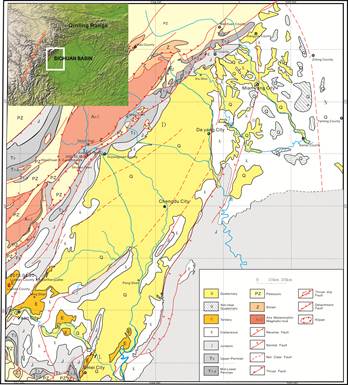
Figure 1. The geological map of Chengdu Basin.
Situated in the west of the Sichuan Basin, the Chengdu Basin stands between Longmen Mountain and Longquan Mountain in the east-west direction and extends to Xiushui of Qi’an County in the north and the regions of Mingshan and Pengshan in the south (Figure 1). In the late Cenozoic era, the edge of the basin descended abruptly to form a highly thick layer of Quaternary sediments dominated by sedimentation of mountain-front molasse and sand-conglomerate (Liu, 1983), while Longmen Mountain was uplifted dramatically at the southeastern edge of the Qinghai-Tibet Plateau. The formation is not only attributed to climatic conditions and effect of water flow, but also restricted by the strength and pattern of tectonic movement, so it contains abundant information on tectonic movement and deformation. In addition to ideal geographic and tectonic conditions, the region is always one of the key regions in the study on the late Cenozoic deformation of plateau, the uplift of plateau and the paleogeographic and palaeoclimatic changes (Xu et al., 1997). Meanwhile, it is also crucial to the study on the changes of climate & water system and ecological environment in the upstream region of the Yangtze River (Liang et al. 2014).
Read full scientific paper in SciencePG for free:http://bit.ly/1UGkpsC


2015年9月6日星期日

Share:Seabirds find fine dining among jellyfish


Seabirds may have unknowing allies in their hunt for fish. Several years ago, a Japanese seabird specialist now studying the effects of climate change on life in Alaska’s Bering Sea noticed that some birds seemed to target clusters of jellyfish. Last summer, he went back to Alaska and outfitted eight thick-billed murres (Uria lomvia), 45-centimeter-long black and white birds that nest on island cliffs, with the avian equivalent of a GoPro camera and a device that tracked their movements. Half of the resulting videos documented underwater excursions, which included 197 feeding events. In 85% of the birds’ U-shaped dives, they encountered the jellyfish Chrysaora melanaster (pictured above), a common species in that area, on their way back up. About one-fifth of the time, the birds altered their ascent to go after young fish hiding among the jellyfish, the seabird specialist and his colleagues report online in Biology Letters. The more fish hiding under the jellyfish, the more likely the birds were to attack, they note. In recent years, it seems that the number of jellyfish have been on the rise, fueling concerns that their voracious appetites for microscopic sea creatures might have a negative impact on the food web and that their density might alter how fish behave—young fish seek refuge among the jellies’ tentacles, for example—and consequently hamper the ability of predators to catch these fish. But this study shows the opposite can be true as well, with jellyfish creating more opportunities for sea birds. Next, the researchers plan to study murres in years when jellyfish numbers are down.
Story source:http://bit.ly/1KVxmsB

2015年9月5日星期六

It’s Easy to Be Fearless When You Have a Good Shell

Screen Shot 2015-09-04 at 8.11.38 AM
Aesop never penned a fable about a snail. If he had written about a certain freshwater mollusk, the moral might have been Boldness comes from a strong shell or maybe Careless snails get chomped. But because the snail and its variable shell are real, their lesson has more to do with the the weird workings of evolution.
Individual Radix balthica snails can have differently shaped shells. They also have varying “personalities,” at least as far as you can measure such a thing in a mollusk. To see whether their shells and personalities were linked, Johan Ahlgren, a researcher at Lund University in Sweden, gathered snail eggs from four nearby ponds.
Back in the lab, Alberg waited for the eggs to hatch. He fed the young snails algae and lettuce until they were grown. Then he subjected the animals to a personality test.
The trait that interested Ahlberg and his colleagues was “boldness.” Measuring an animal’s boldness or shyness is a common way to study personality in species all across the animal kingdom: Does it readily explore a new space? Does it stand frozen in a corner? In snails, shyness means staying inside your shell. So Ahlberg gently prodded the snails’ shells with tweezers to frighten them (“The snails retracted after one poke,” the scientists write). Then he counted the seconds until the animals stuck their heads back out.
After repeating the experiment a week later, Ahlberg could sort the snails into two groups. Bold snails consistently emerged from their shells in under 10 seconds. Shy snails took 15 seconds or longer. Some especially timid individuals waited three or four minutes before daring to poke their antennae out.
Next, Ahlberg scanned the shells of all the snails and analyzed their shapes. There were significant differences, he discovered, between the shells of bold and shy snails. Bold individuals had rounder shells with wider openings. Shy ones had more elongated shells with narrower openings.
shells
Shells that are round with wide openings are harder for fish to crush and eat, the authors write. So bolder snails have safer shells. In other words, they can afford to be bold, because they have better protection from predators.
Links between personality and body type have shown up in other animals. Bolder anole lizards have tails that break off more easily, for example. As in the snails, animals with a more fearless personality seem to balance that trait with a body that’s safer from predators.
Do the snails learn to be bold because they grow up with sturdier shells? Although this is possible, the authors write, in this experiment all the snails grew up in the lab, safe from predators. Their personalities emerged without any experience of fish trying to eat them. So it seems that the two traits—boldness and well-defended shells—are genetic, and have evolved alongside each other.
The scientists call this “the ghost of predation past.” The hungry fish that pursued R. balthica in its history have left their mark on its DNA. Today, even if they grow up in a safe space, snails only act fearless if their bodies can back them up.
Or maybe they learned from Aesop: Preparedness for war is the best guarantee of peace.
fox and boar
Images: Top, illustration by Milo Winter for “The Tortoise and the Ducks” (Foolish curiosity and vanity often lead to misfortune) from Aesop’s Fables; middle, Ahlgren et al. (2015); bottom, illustration for “The Wild Boar and the Fox” (Preparedness for war is the best guarantee of peace), same source as top.
Ahlgren J, Chapman BB, Nilsson PA, & Brönmark C (2015). Individual boldness is linked to protective shell shape in aquatic snails. Biology letters, 11 (4) PMID: 25904320
Story source: http://bit.ly/1JIVTNf (http://blogs.discovermagazine.com/)

2015年9月2日星期三

International Journal of Literature and Arts

International Journal of Literature and Arts (IJLA), a peer-reviewed open access journal published bimonthly in English-language, aims to foster a wider academic interest in literature and arts, and publishes a wide range of researches on literature studies, art theory, appreciation of arts, culture and history of arts and other latest findings and achievements from experts and scholars all over the world. Each issue contains a variety of critical articles, an extensive book reviews section, a selection of original poetry, and the visual and performing arts, and so on.

ISSN:2331-0553 (Print)
ISSN:2331-057X (Online)
About This Journal
International Journal of Literature and Arts (IJLA) is a peer-reviewed, open-access journal featuring research articles of exceptional significance in all areas of literature and arts. Subject areas may include, but are not limited to the following fields:
  • • Architecture
  • • Art history
  • • Art theory
  • • Appreciation of arts
  • • Children's literature
  • • Culture heritage
  • • Cultural issues
  • • Folklore
  • • Latin
  • • Literature
  • • Media studies
  • • Music
  • • Visual and performing arts
  • • Writing
  • So, if you like, you can read all latest issue about these subjects in this journal for free:http://bit.ly/1Ey0WD4